
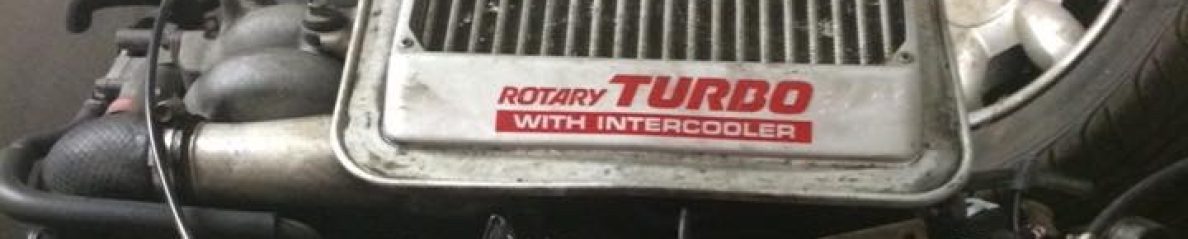
Details on the history of the Rotary Engine can be found here: Wankel Engine
Details on the specifics of different Mazda made engines can be found here: Mazda Wankel Engines
Details on how the rotary engine generally works can be found here:How Rotary Engines Work
- Early Engines (10A)
- 12A
- 12A Turbo
- 13B Series 3/4/5 N/A (FB GSL-SE + Non-Turbo FC)
- 13BT Series 4
- 13BT Series 5
- 13B-RE Cosmo
- 13B-REW Series 6,7,8
- 13B-MSP
- 20B
- R26B
- Component Diagram
- Front Cover
Early Engines (10A)
Mazda was not the only company to study the design from Felix Wankel, the likes of GM, Rolls Royce, and NSU all neared or brought a rotary engine as internal concept for study. Ultimately acquiring the development rights from NSU, Mazda would ultimately iterate on the Wankel Design to bring the engine to a production vehicle (after NSU) in the Mazda Cosmo as the 10A engine.
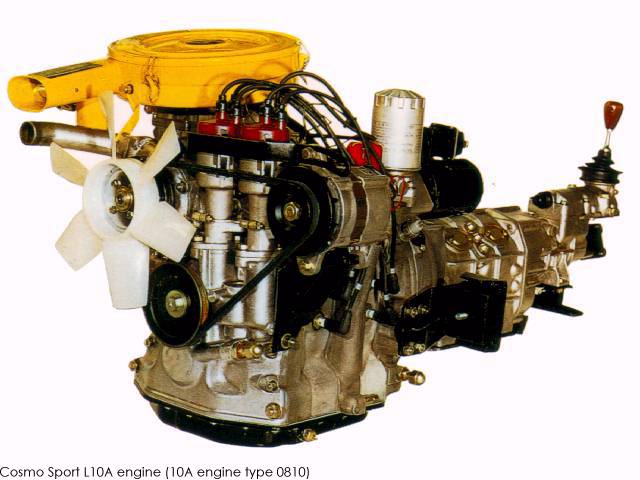
Details on the Mazda 10A engine can be found here in a bunch of research Craig did into the subject: http://cp_www.tripod.com/rotary/pg16.htm
While the engines are incredibly rare, if you somehow happen to stumble across one, I suggest you sell it to fund the swap, rather than using it for the swap.
12A Generation
12A
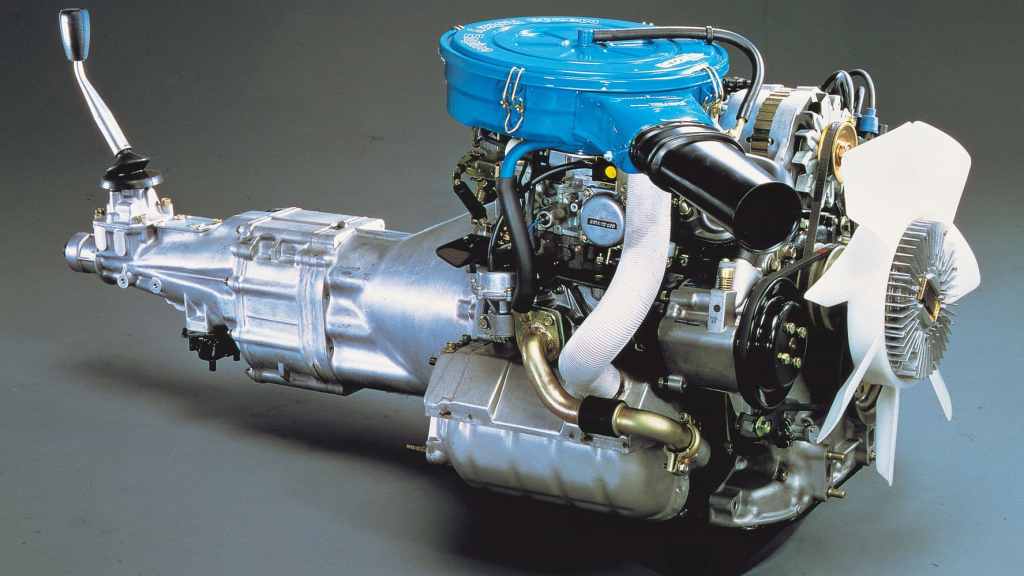
The 12A engine can be found in RX3, RX4, and RX7 (SA and FB) generations as the main early powertrain Mazda used for early production. An excellent swap candidate if you can source one; however, due to limited production, sourcing a complete running engine is becoming more difficult by the day.
Detailed information on the 12A can be found here: Low Offset – 12A Engine
The following information was largely taken from: Haltech – Tuning Rotary Engines
12A Turbo
Available in the JDM RX7 Sereis 3 and some HB Cosmo models. This was a popular easy engine swap for all RX7 Series 1,2,3 models with it being a direct bolt in replacement engine. Easily identified by the orange hat on top of the carburettor-style throttle body. They have extremely small ports, small throttle, and as such make very little power. Distributor ignition with boost retard diaphram.
13B Generation Engines
13B Series 3/4/5 N/A (FB GSL-SE + Non-Turbo FC)
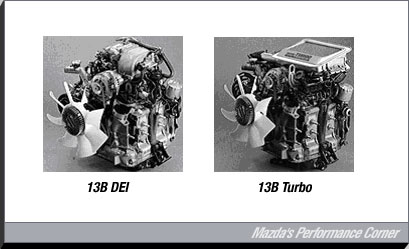
Pictured on the left above, the DEI engine was introduced in the GSL-SE as the 13B. This was an iteration on the 12A engine. With the switch to the 13B, some parts from the older 10A/12A engines were not compatible, namely the rotors. The rotors thus housings, and other key components, on the 13b engine are 10mm wider than the previous 12A engine. This is were the extra displacement of the engine is sourced. The front cover does however swap between the engines, and it is very common practice to use a 12A front cover in a 13b swap as the 12A front cover has engine mounts.
These engines are commonly referred to as “6 port” engines, while the S4/S5 Turbo engines are commonly referred as 4 port engines.
13BT Series 4
Found more commonly in the 1986-1988 RX7. Identified by the mechanical rod oil metering pump, twin scroll turbo with control diaphram, straight tube intercooler feed pipe, single TPS, 8.5:1 comp. Waste spark ignition with Toggle-style Trail igniter. This ignition runs the same as a Distributor but has a signal from the ECU to tell the igniter to alternate the output between two coils.
13BT Series 5
Found more commonly in the 1989-1991 RX7. Idenitifed by a stepper motor oil metering system, 2x TPS, larger turbo with no twin scroll, tapered intercooler feed pipe, 9.0:1 comp. Same ignition as Series 4. It is also known to have hardened front and rear stationary gears.
13B-RE Cosmo
Found only in the JC Cosmo. All were automatic transmissions. Very large end plate ports. Sequential Twin Turbos. Serpentine dirve belt. No inspection cover for flywheel on end plate.
13B-REW Series 6,7,8
Found in the FD RX7 Series 6,7,8. As per Cosmo engine with smaller end plate ports. Larger secondary injectors. Waste Spark Ignition.
13B-MSP
Found in the RX8. Exhaust ports moved from housing to end plates as per intake ports. DBW. Motor controlled port actuators. 10.0:1 compression. Naturally Aspirated. Direct Fire ignition. Manual transmission models have 3x injectors per rotor.
20B
Found only in the JC Cosmo with all having an automatic transmission. 3-rotor engine with Sequential Twin Turbos, specs otherwise similar to the 13B-RE. 2x Dual-Toggle igniters which run in the same way as Series 4/5 ignition but have 3x outputs fired in sequence. OEM igniters are NOT supported by Haltech ECU’s.
R26B
Made famous from Mazda’s win at Le Mans. Not available to the public. There are a number of 4-rotor kits that use custom crankshafts and end plates available on the market.
Other Information
Displacement
Elite ECUs required the true displacement to be entered for VE tuning, as listed below.
| Engine | Displacement |
|---|---|
| 10A 2-rotor | 982cc |
| 12A 2-rotor | 1146cc |
| 13B 2-rotor | 1308cc |
| 20B 3-rotor | 1962cc |
| 26B 4-rotor | 2616cc |
Engine Components
Component Diagram
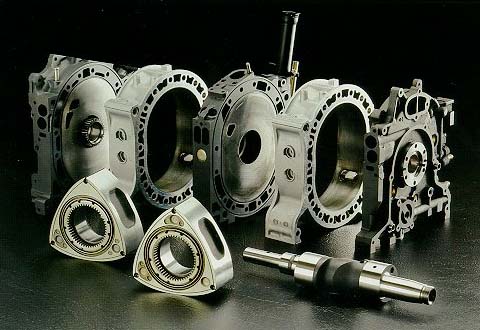
From left to right, back row, the left most component is a rear iron, then a rear housing (here it is pictured backward, as exhaust port should be on same side as intake), the middle iron, the front housing (again, backward…), and then the front iron. Front row, left to right, rear rotor, front rotor, eccentric shaft.
Notable components which are missing from above:
- Front Cover
- Oil Pan
- Oil Pump
- Front Stack
- Dowels
- Engine Bolts
- Exhaust Manifold
- Lower Intake
- Upper Intake
- Throttle body/Carb
Front Cover
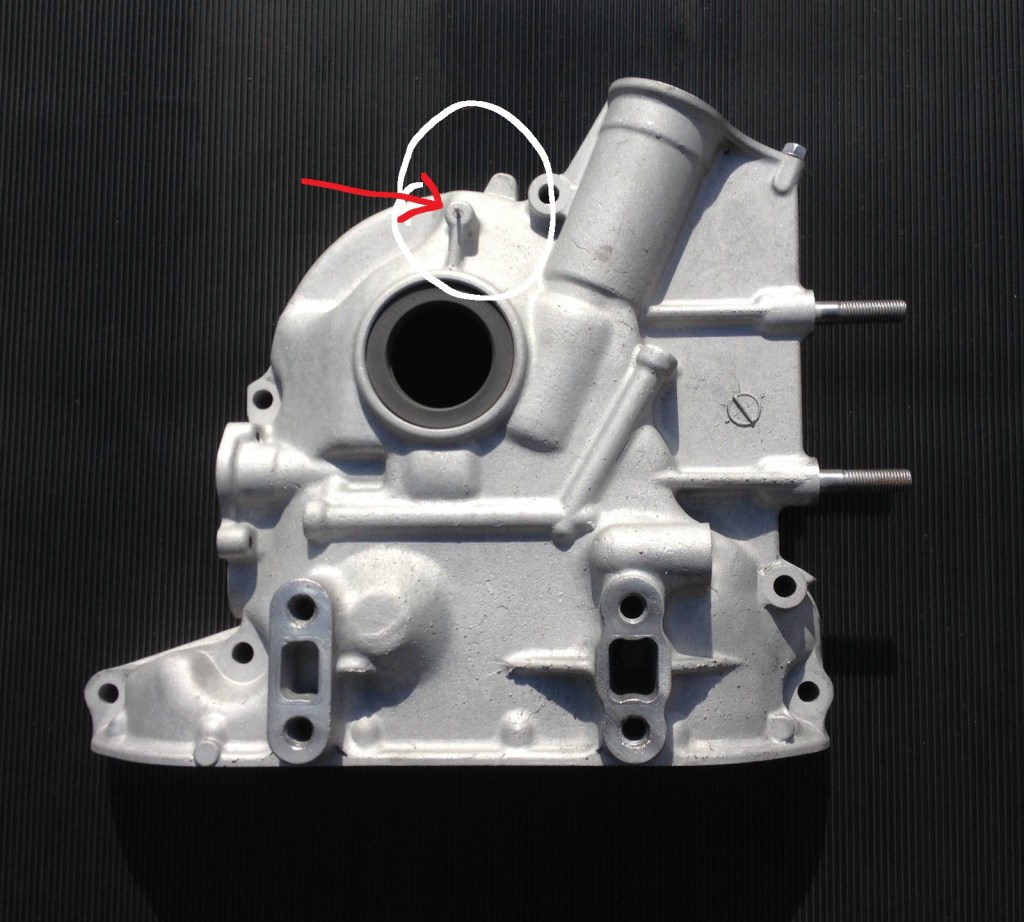
(Above) 12A Front Cover
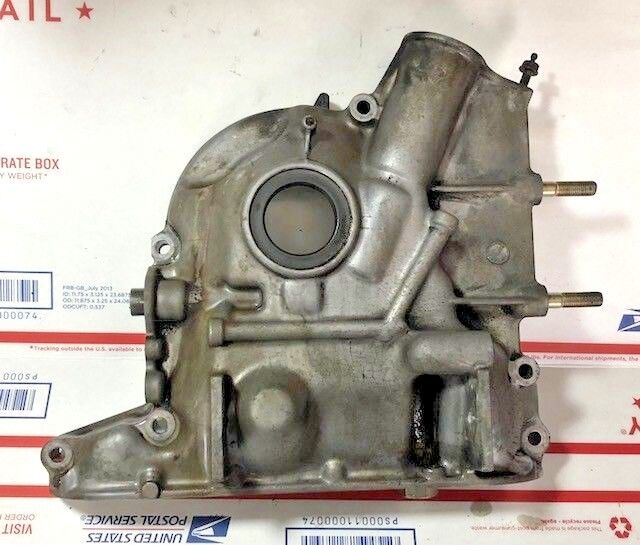
(Above) 13B Front Cover
Above, the main differences in the front covers can be seen, notably, ignoring the circled portion of the 12A cover photo (it was the best picture I could find on the internet), there are 4 holes which are notably missing from the 13b (right) front cover. The 12A front cover will fit on 13b engines, and is very common to use in a swap. In fact, Racing beat sells a 12A to 13B mount kit to aid in the swap for older FB Rx-7s.
 Rotary Miata