
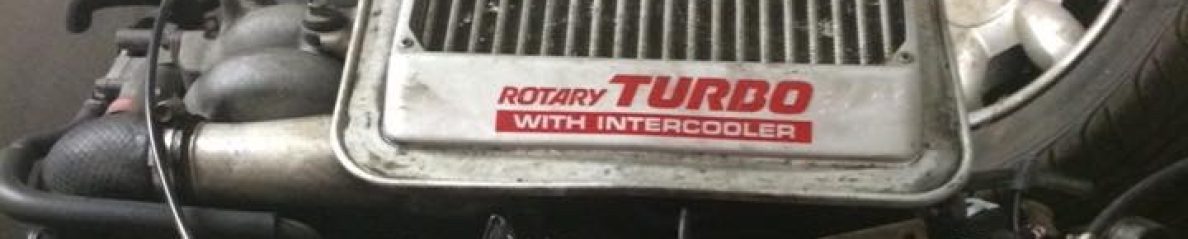
Welcome to Rotary Miata!

This webpage is a large work in progress, there is a load of valuable information here already, but more to come. Email me or join the FB group for specific questions. Disclaimer: Any modifications you perform are done at your risk, the content of this website is for entertainment and information sharing only. If you are not confident, consult an expert.
I’ve spent spent the last 8 years researching and building a 13b S5 Turbo II swapped NA Mazda Miata. I have gained quite a bit of knowledge on the subject and aim to share this information here with you through this website.
When undertaking this swap, you should start with your end goal in mind. This swap is unique, growing more expensive by the day, and not for the faint of heart. If you are wanting a high horsepower build, this is not the drivetrain to choose. A turbo LS or Honda K series are much cheaper builds for the money.
- V8 Roadsters LS Swap Kit: https://v8roadsters.com/product/lsx/
- Kmiata K series swap kit: https://kpower.industries/collections/kmiata-swap-parts/products/ultimate-k24-miata-swap-conversion-package
Outside of the above, you can build a high HP BP6 or BP8 for FAR cheaper than this swap will ever cost. This isn’t meant to discourage you, but its to be serious. This swap at its absolute cheapest, will be nearly $6k, and will have less than or near stock power levels.
Okay, with that out of the way, there is another elephant to talk about. Excluding the Renesis engine, the 2 rotor was not brought to the US by Mazda after 1995, and was not produced worldwide after the early ’00s. While the cult following of the engine has kept Mazda producing components, these engines are in admittedly short supply compared to the above platforms. Since 1967, Mazda has produced 2-million rotary powered vehicles, in total, including Rx8. Meanwhile, Honda produces 1.8 million vehicles / year, many with a variant of the K series, and the LS engine everyone knows is a dime a dozen (or it was!). While 2 million is nothing to scoff at, in the past nearly 60 years, several of those engines have gone by the wayside.
If you take a look at any of the Turbo 13b engines, you will quickly understand the impact this limited supply has had on them, and a growing enthusiast base pushing for a higher demand. It’s not uncommon to see a FC Turbo II drivetrain for $7,500 and an FD drivetrain for $10k-$12k! Thats just for the engine! Unmodified, the Turbo II was spec’d for 179hp, and the FD for 184hp. Again, while it is an improvement over the stock BP power, it’s nothing to write home about, when for the same price, you can have a 500hp+ capable K or LS….
Okay, so if you are still reading this, you’ve acknowledged this is NOT the way to get high horsepower, and the platform is getting rarer by the day, causing inflation of the parts still around. But you still want a rotary in a Miata. The way the car was originally concepted by one of the design teams at Mazda. You have to understand this is a swap for those who love the platform, and nothing else.
Now with that out of the way, I think we can start to talk about what you are here for! All-in-all, there are many different ways to complete this swap, all, currently, will require some amount of fabrication.
The absolute cheapest way to do this swap is as follows:
- Heavily modified stock subframe
- NA 13b, full carb conversion, distributor converted, stock ports, no rebuild.
- Tailhousing swap to retain ppf thus stock drivetrain
- Custom radiator hoses, using the stock miata radiator and fans
- Oil cooler
- Custom exhaust
- Custom Clutch line
Doing the above, will get you a rotary into a Miata, with a few extra steps of ironing out odds and ends. I won’t be covering each of the above steps in this site, but will cover several of them. I personally would recommend against the heavily modified stock subframe, for example, and would instead opt for V8Roadsters tubular subframe.
Now that we’ve covered all the reasons to NOT do this swap, I have organized the information on this website up in 3 main parts.
In this section, I’ve covered the basics of rotary engines, and what to choose.
Generally, if you want to stay Naturally Aspirated, a 12A engine will be the simplest. Meanwhile, if you are wanting to go turbocharged, I would recommend a 12A Turbo, 13B S5 TII, 13B RE, or 13B REW engine. There are many improvements over the S4 Turbo engines to make them worthwhile to stay away from.
2 – Getting Started
In this section, we will cover the barebones basics of completing this swap. There will be welding involved in various parts, but it should be infrequent enough to hire a friend, or take the pieces to a shop with good mockups. Do not let welding dissuade you from doing this swap, you CAN plan and complete this swap.
This will cover the most cost effective barebones swap, hoping to cover EFI and carbureted setups.
In this section we will cover
- Subframe and engine mounts
- Wiring basics
- Cooling system
- How to retain factory transmission mount
- Customizing the exhaust
- Fuel system
- Oil cooler
2 – The Options
In this section, we will document various ways to deviate from the most barebones swap. While not intended to be a cover-all, various topics will be discussed. Example, how to adapt RX7 AC Compressor to work with Miata components. Turbo setups, Electronic power steering, V-mounts, Tranmission mounts, PPF deletes, aftermarket rear-ends, etc.
The Getting Started section is intended to cover the most basic of swaps, or what all swaps will require.
This information is useful in understanding the ins and outs of what any swap may require.
While ‘The Options’ is geared toward the many, many different ways a swap could deviate.
– Turbo
– A/C
– Power Steering
– PPF Delete
– etc.
This page is still a work in progress, if you have information you would like to share, or if you would like me to explain how something was done, please fill out the contact form below and I will do my best to add it to the backlog of items.
{contact form placeholder} for now, email me directly at haydenjallen96@gmail.com
 Rotary Miata